
India throws away 1.59 lakh tonnes of waste every single day. That’s not a typo. Every. Single. Day.
Most people read that and think pollution. But a growing set of investors are reading it differently — as a business opportunity hiding in plain sight. India’s waste management market is currently valued at $14.29 billion (2026) and is expected to reach $18.94 billion by 2031. The recycling and resource recovery segment alone is growing at an 8.5% CAGR — the fastest of any segment in the sector.
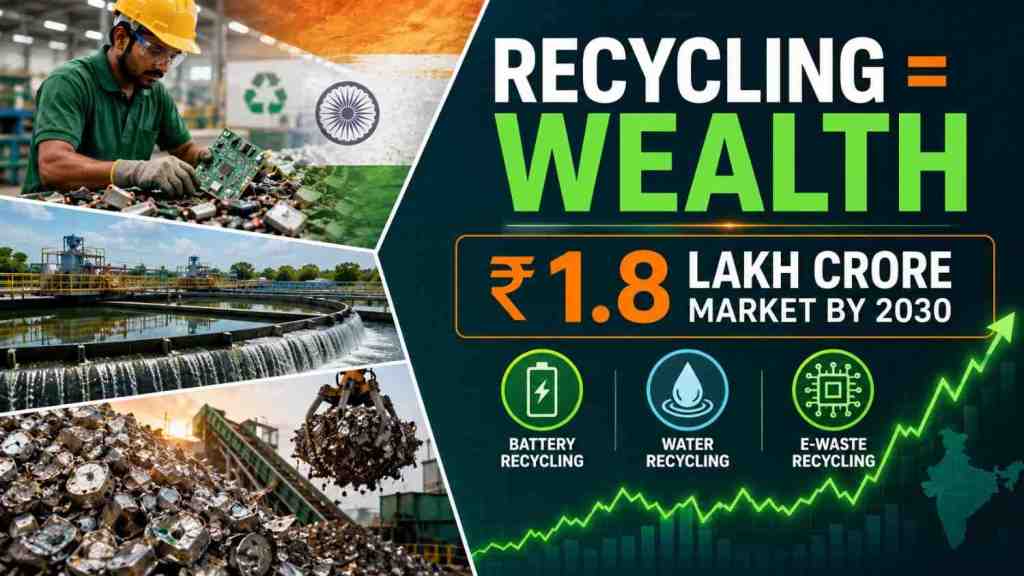
This is not a speculative story. It is a structural, government-backed, regulation-driven shift. And three listed Indian companies are sitting right at the center of it.
An Investment Opportunity For Investors
Before we get to the stocks, you need to understand why this is happening now and not five years ago.
The Waste Numbers Are Staggering
India produces around 160,000–170,000 Tonnes of municipal solid waste (MSW) daily. Annual waste generation is projected to reach 165 million tonnes by 2030. The country’s e-waste market alone was valued at $3.32 billion in 2025 and is expected to reach $9.95 billion by 2034, growing at a CAGR of 11.59%.
These are not small numbers. They represent millions of tonnes of lead batteries, smartphones, aluminum cans, plastic packaging, and industrial water — all of which need to be collected, treated, and recycled.
The Government Has Entered the Chat
Here is what changed the game: Extended Producer Responsibility (EPR).
Under India’s E-Waste Management Rules 2022, manufacturers are now legally required to collect and recycle a mandatory 60% of their e-waste in 2025–26, rising to 80% by 2027–28. If they don’t, they face environmental compensation levies of ₹5,000 to ₹20,000 per tonne.
This means every smartphone brand, laptop company, and electronics manufacturer in India must either set up their own recycling pipeline or pay licensed recyclers to do it. That is a guaranteed revenue stream flowing directly into organized recyclers.
On the battery side, FAME-III EPR rules are expected to drive lithium-ion battery recycling volumes to more than triple between 2026 and 2031.
The government has also allocated ₹1,41,600 crore ($17 billion) through 2026 to fund material recovery and waste-to-energy plants under Swachh Bharat Mission 2.0.
When policy, money, and urgency align — that’s when sectors move.
The Shift from Linear to Circular Economy
The old model: make a product, use it, throw it away. The new model: make a product, use it, recover the materials, make another product.
India is being pushed into this circular economy model partly by regulation and partly by economics. Recovered lead from old batteries is cheaper than mining fresh lead. Recycled Aluminum uses 95% less energy than smelting new Aluminum. As commodity prices stay elevated and global supply chains remain fragile, recycled materials become increasingly cost-competitive.
This is the structural tailwind every investor should understand before looking at individual stocks.
Top 3 Stocks for Investments Purpose
This is my analysis on these stocks to buy or Growth Potential. Please Invest at your own risk.
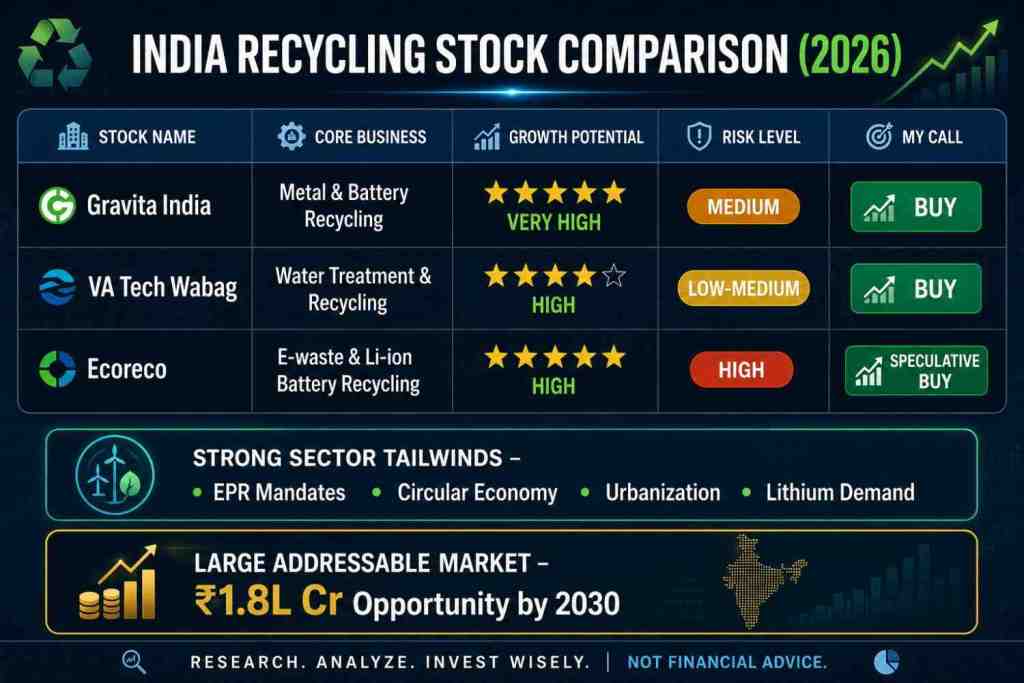
- Gravita India (NSE: GRAVITA)
Gravita India is founded in 1992. It is one of India’s largest integrated metal recyclers. Their core business is lead recycling — specifically recovering lead from used lead-acid batteries (the ones in cars, inverters, UPS systems). They then smelt and refine it into lead alloys and sell it back to battery manufacturers.
But Gravita has been aggressively expanding. They now also recycle aluminum, plastic, and rubber, and have recently announced a new copper recycling plant in Gujarat. They operate in over 38 countries with a global procurement network for scrap.
The profit growth is outpacing revenue growth — which is the hallmark of a business with operating leverage. They’ve also raised ₹1,000 crore through a Qualified Institutional Placement (QIP), signaling institutional confidence.
The company’s stated “Vision 2028” targets a 25%+ volume CAGR and 35%+ profitability CAGR, with return on invested capital (ROIC) above 25%. They are also setting up a ₹160 crore greenfield copper recycling plant in Mandvi, Gujarat, with a capacity of 29,400 MTPA — a new revenue vertical entirely.
Gravita’s margins are exposed to commodity cycles. Lead prices, aluminium prices, and recycled metal realizations fluctuate. In Q4 FY26, profit actually dipped slightly (−3.4% YoY) even as revenue grew 13%, because input costs (raw material consumption) rose 26.5%. So strong volume growth doesn’t always immediately translate to profit growth.
Current Price & Valuation (as of June 2026): ~₹1,631 | Market Cap: ~₹12,036 crore | 52-week range: ₹1,267–₹1,94
2. VA Tech Wabag (NSE:WABAG)
VA Tech Wabag is a global water solutions company — they design, build, and operate water treatment and wastewater recycling plants. Think of it this way: every time a city needs to clean its sewage water and recycle it for industrial use, or a factory needs to treat its effluents before releasing them, VA Tech Wabag is often the company building and running those systems.
Their clients include municipal corporations, industrial companies, and government bodies across India and internationally. Key contracts include work under India’s Namami Ganga program (Ganga river cleaning) and Smart Cities Mission.
That order book number is crucial. At ₹17,200 crore — representing over 4.4x FY26 revenue — Wabag effectively has years of confirmed work ahead of them. The company has been net cash positive for six consecutive years, which in an infrastructure company is exceptional. They have no net debt; in fact, they hold a gross cash position of ₹1,059 crore.
Wabag is expanding into three new segments: ultra-pure water (required for semiconductor fabrication and data centers), green hydrogen (which needs highly purified water), and Bio-CNG (in partnership with PEAK Sustainability Ventures, with plans for up to 100 plants across India). These aren’t niche sidebets — they are directly aligned with India’s technology and energy transition goals.
Management guidance for FY27 includes 15–20% revenue CAGR with bottom-line growth expected to exceed top-line growth.
Institutional Confidence
Rekha Jhunjhunwala (wife of the late Rakesh Jhunjhunwala) held an 8% stake in the company as of Q4 FY26 — a meaningful endorsement from one of India’s most closely watched investor families.
Current Price & Valuation (as of June 2026): ~₹1,500 range | P/E: ~25.6x | 52-week high was hit post-results in May 2026
3. Eco Recycling (BSE:ECORECYCL)
Ecoreco is one of India’s earliest and most recognized e-waste recycling companies. They handle the full cycle of electronics disposal: collection, dismantling, shredding, precious metal recovery (gold, silver, palladium), lamp recycling, and secure IT asset disposition (data destruction). That last part — secure data destruction — is a premium service that large corporates, banks, and multinationals pay a significant premium for.
This is a niche that’s harder to commoditize. A bank doesn’t just need its old laptops recycled; it needs a certified, audited chain of custody proving that data was securely destroyed. Ecoreco has built its reputation around exactly this offering.
Why EPR Changes Everything for Ecoreco
Before EPR enforcement, much of India’s e-waste flowed to informal recyclers — backyard operations with no certifications, no compliance, no oversight. Now, with mandatory 60% collection targets and steep penalty structures, corporations have to route their e-waste to authorized recyclers like Ecoreco. That is a regulatory moat.
The Financial Context
Ecoreco is a smaller company than Gravita or Wabag — much smaller. But the market it addresses is growing fast. India’s e-waste management market was valued at $1.88 billion in 2025 and is forecast to reach $2.87 billion by 2031 (CAGR of 7.32%). A separate estimate from IMARC Group projects it could reach $9.95 billion by 2034 at an 11.59% CAGR (depending on methodology and scope).
Ecoreco is currently in an early-stage growth phase where execution and volume ramp-up matter more than steady-state margins. Their competitive moat is their position as a pioneer with certifications, corporate relationships, and brand trust in a segment where trust matters enormously.
For Ecoreco, the key variables are: EPR enforcement strictness (tighter = better for them), corporate client acquisition pace, and whether they can scale profitably. Commodity price volatility in precious metals also affects realizations on recovered gold and silver.
Top Risks For These Stocks
This is a real growth sector, but that doesn’t mean risk-free.
Commodity Cycles:
Gravita’s profits directly correlate with lead and aluminium prices. When metal prices drop, margins compress even when volumes grow. Q4 FY26 was a preview of this.
Execution Risk: For VA Tech Wabag, a ₹17,200 crore order book is only as good as the ability to execute those contracts on time. Government infrastructure projects in India have a historical tendency to face delays. Wabag’s track record has been solid, but this remains the key variable.
Regulatory Enforcement Uncertainty:
The entire e-waste thesis rests on EPR enforcement actually being enforced. India’s history with environmental regulation has been mixed. If enforcement is weak, the demand shift from informal to formal recyclers may be slower than expected.
Valuation:
These are no longer “undiscovered” stocks. Both Gravita and Wabag trade at meaningful premiums to the broader market, reflecting future growth expectations. If earnings disappoint, de-rating risk is real.
Fragmented Market:
The top five players in India’s waste management sector account for less than 18% of total revenue. This means the market is large but highly competitive, with hundreds of smaller regional players.
Experts Analysis For These Stocks
Here are some Experts Analysis on these stocks .
Motilal Oswal (on VA Tech Wabag, July 2025):
Reiterated “Buy” rating, setting a target price of ₹1,920, noting the company’s current order book of ₹137 billion (4.2x FY25 revenue) and a strong bid pipeline of ₹150–200 billion provide 15–20% revenue growth visibility. They flagged that VA Tech Wabag’s strategic partnership with Norfund and recognition among the top three global desalination players are significant positives.
AXIS Capital (on Gravita India, September 2025):
Noted that stricter regulatory measures resulted in a 60% surge in domestically sourced scrap, strengthening raw material security, and that Gravita’s value-added product mix improving to 46% of revenue supports margin expansion, while its net debt-free status post the ₹1,000 crore QIP is a key competitive advantage.
Rating Agencies:
Both Gravita India and VA Tech Wabag now carry an AA- credit rating from major agencies, reflecting improved financial health and execution track record. This rating upgrade lowers borrowing costs and enhances institutional investor confidence.
Investments Strategies for Investors (My Opinion) –
Moderate Long-term (3–5 years) Gravita India – most diversified, debt-free, strong 5-year CAGR
Low-moderate Conservative growth investors VA Tech Wabag – large order book, global presence, consistent dividends
High Aggressive small-cap investors Ecoreco – zero debt, high growth potential but volatile
For most investors, a balanced approach works best: Gravita India for recycling diversification, VA Tech Wabag for stable growth and dividends, and Ecoreco for high-upside exposure to the e-waste boom.
Conclusion
India’s recycling and waste management industry appears to be moving from a niche segment toward a mainstream economic opportunity. Rising waste generation, stricter environmental regulations, EPR compliance requirements, and growing sustainability awareness are creating long-term demand for organized recycling businesses. For investors, Gravita India offers a strong recycling-focused play, VA Tech Wabag provides exposure to water reuse infrastructure, and Ecoreco represents a higher-risk, higher-potential e-waste opportunity. While risks remain, the sector is worth watching as a potential long-term structural growth theme.
Disclaimer:” This article is for educational and informational purposes only and does not constitute investment advice. Stock market investments carry risk. Please consult a SEBI-registered investment advisor before making any investment decisions. Data sourced from company filings, BSE/NSE disclosures, and publicly available market research.“
FAQs
If waste generation, sustainability regulations, and circular economy adoption continue growing, recycling could become a significant long-term investment theme over the next decade.
Yes. Risks include regulatory changes, commodity price volatility, project delays, and valuation concerns
3. is e-waste recycling a growing industry in India ?
Yes. Rising electronics consumption and stricter EPR regulations are expected to increase demand for organized e-waste recycling services.

Leave a Reply